A missing tooth can change more than a smile. You may start chewing on one side, avoid certain foods, cover your mouth when you laugh, or wonder whether the space will cause problems later. The best ways to replace missing teeth depend on how many teeth are missing, where they are located, the health of your gums and jawbone, and what feels manageable for your budget and comfort.
There is no one right choice for every patient. A calm conversation and a thorough exam can make the decision feel much less overwhelming. The goal is to restore comfortable chewing, support your oral health, and help you feel like yourself again – without pressure or surprises.
Why replacing a missing tooth matters
A gap in your smile is not always an emergency, especially if it is a back tooth and you are not in pain. Still, leaving it untreated can create changes over time. Nearby teeth may begin to drift into the open space, which can affect your bite and make cleaning more difficult. The opposing tooth can also grow farther out of its normal position because it no longer has a tooth to meet.
Missing teeth can make it harder to chew nutritious foods comfortably. Depending on the location of the gap, they may also affect speech, facial support, and confidence. When a tooth is lost because of decay, gum disease, or injury, an exam also helps identify and address the cause before it affects other teeth.
Best ways to replace missing teeth
The right restoration should fit your health needs and your everyday life. Some options are fixed in place, while others are removable. Some replace the visible tooth only, while others also support the jawbone beneath it.
Dental implants
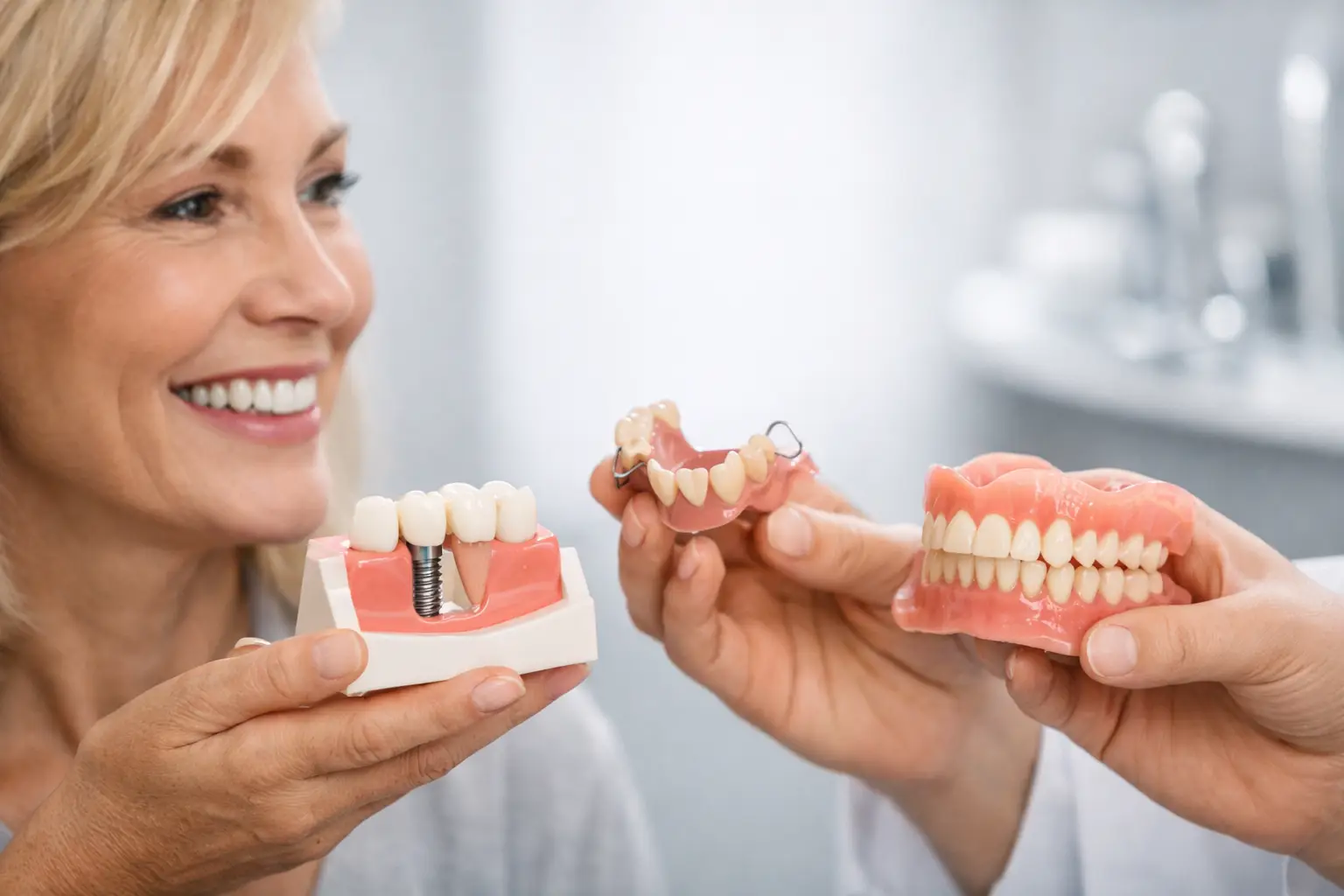
A dental implant replaces the root of a missing tooth with a small post placed in the jawbone. Once the area has healed, the implant can support a custom crown for one missing tooth, a bridge for several teeth, or a full arch of replacement teeth.
Implants are often the closest option to a natural tooth because they are stable, do not need to be removed at night, and allow you to chew with confidence. They also stimulate the jawbone, which can help reduce bone loss after a tooth is lost. Unlike a traditional bridge, an implant usually does not require reshaping the healthy teeth beside the gap.
The trade-off is time and cost. Implant treatment involves a surgical procedure and a healing period, which can take several months depending on your needs. Some patients need additional treatment, such as bone grafting, before an implant can be placed. Good gum health, enough bone support, and consistent home care are all essential for long-term success.
For patients who feel nervous about dental procedures, it helps to know that implant treatment is carefully planned and can be approached step by step. Ask about comfort options, timing, and what to expect at each visit. Feeling informed can make a major difference.
Dental bridges
A dental bridge fills a gap by connecting a replacement tooth to the teeth on either side. A traditional bridge is held in place by crowns on the neighboring teeth. It is fixed in place, so you do not take it out to clean it, and it can restore your ability to chew and speak more normally.
A bridge can be a practical choice when the teeth beside the space already need crowns or have large fillings. It is usually completed more quickly than an implant and does not involve implant surgery. For many patients, that makes it a comfortable middle ground between a removable denture and an implant.
The main consideration is that a traditional bridge requires preparation of the adjacent teeth, even if those teeth are otherwise healthy. Cleaning under the replacement tooth also requires special floss or a small brush. With attentive care and regular checkups, a bridge can be a dependable solution for many years.
Partial dentures
A partial denture is a removable appliance that replaces one or several missing teeth. It is designed to fit around your remaining teeth and can be made with a metal or flexible base, depending on your needs. Modern partial dentures can be more natural-looking and comfortable than many people expect.
This option can be useful when several teeth are missing in different areas of the mouth or when a fixed treatment is not the right fit at the moment. It is generally more affordable upfront than implants and can often be made without altering neighboring teeth as extensively as a bridge would.
Because a partial denture is removable, there is an adjustment period. It may feel different when speaking or eating at first, and it needs to be removed daily for cleaning. The fit should be checked regularly, since your mouth and gums can change over time.
Full dentures and implant-supported dentures
When all teeth in the upper or lower arch are missing, a full denture can restore appearance and basic chewing function. Conventional dentures rest on the gums and are removable for cleaning. They can be an accessible way to replace a full set of teeth, particularly when surgery is not desirable or possible.
Some people find that lower dentures move during meals or conversation. Implant-supported dentures can offer more stability by attaching a denture to strategically placed implants. Depending on the design, the denture may still be removable at home or fixed in place by the dental team.
Implant support may improve comfort, confidence, and chewing ability, but it adds surgical treatment and cost. A dental exam can show whether your bone and health history make this a suitable option.
How to choose the right tooth replacement option
Start with the practical details: How many teeth are missing? Are the nearby teeth healthy? Is there enough jawbone for an implant? Do you need a solution quickly, or can you allow time for healing? Your dentist will also consider your bite, gum health, medical history, and the way you want your smile to look.
Your priorities matter just as much. If you want a fixed option that feels closest to a natural tooth, an implant may be worth considering. If you need to replace a tooth sooner and the neighboring teeth need crowns anyway, a bridge may make sense. If several teeth are missing and budget is a primary concern, a partial or full denture may be an appropriate place to start.
It is also reasonable to ask for a phased plan. For example, a temporary solution may protect your appearance and function while you plan for a more permanent restoration later. There is no benefit in rushing into treatment you do not understand or feel ready for.
What happens after a tooth is lost
If a tooth has just been extracted or knocked out, contact a dentist promptly. In some cases, treatment planning can begin right away, and preserving the bone at the extraction site may make future tooth replacement easier. If a permanent tooth has been knocked out and is still intact, handle it by the crown rather than the root and seek urgent dental care.
Even if the tooth has been missing for years, it is still worth asking about your options. Bone loss or shifting teeth may affect the plan, but they do not automatically rule out treatment. Clear X-rays and a personalized exam provide far more useful answers than assumptions.
Make the decision feel manageable
Cost concerns and dental anxiety should not prevent you from getting clear information. Ask for a written treatment plan that explains what is recommended, why it is recommended, the expected timeline, and the likely fees. Insurance support, payment options, and the possibility of treating one area at a time can make care easier to plan.
At D on D Dental, patients can discuss missing-tooth options in a calm, judgment-free setting. Whether you have avoided the dentist for a while or simply want a second opinion, you deserve straightforward answers and gentle support.
A restored smile does not have to happen all at once. The most helpful next step is simply an exam and a conversation, so you can choose a path that feels comfortable, realistic, and right for you.